Republicans, Democrats and U.S. Crimes Against Humanity: A Chart
| Revolution Newspaper | revcom.us
To our readers: this table is in process of being finalized. Later this week, we will post this in pdf format. If you have ideas on additional crimes or ideas on layout, please send and we will consider. But we strongly feel that even THIS is a stunning and telling indictment of the US ruling class as a whole and the Democratic Party in particular.
U.S. Wars and Interventions
|
President
|
The Human Cost
|
The nuclear bombing of Hiroshima and Nagasaki, August 1945
|
Harry Truman (D)
|
As Japan was suing for peace and World War 2 was coming to an end, on August 6, the U.S. dropped the first atomic bomb ever used on the city of Hiroshima. By the end of 1945, between 140,000 and 150,000 people, overwhelmingly civilians, died from the attack and hundreds of thousands more were wounded. On August 9, the U.S. dropped an even more powerful nuclear bomb on Nagasaki, destroying the city and murdering another 70,000 people.1
|
Military intervention in the Chinese Revolution, 1945-1949
|
Truman
|
For three decades Mao Zedong and the Chinese Communist Party led a revolutionary struggle in China, including a decade long battle that played a major role in defeating the Japanese invasion (during World War 2). After that, an intense battle broke out between China’s revolutionaries and the pro-U.S., reactionary Nationalist Party (Kuomintang/KMT) under Chiang Kai-shek. The U.S. funneled billions in aid and military equipment to the KMT and the roughly 100,000 American troops stationed in China advised, trained, organized, and supported Chiang’s forces, airlifting 500,000 to different battlefronts. Without U.S. backing the KMT would have collapsed or been defeated more—perhaps much more—quickly. So U.S. intervention prolonged the conflict and contributed significantly to the terrible toll on the Chinese people between 1945 and 1949. By 1949, an estimated 2.5 million had been killed, millions more were displaced, the economy collapsed, and tens of millions were left destitute.2
|
Military intervention in Greek civil war, 1947-49
|
Truman
|
In 1947, the U.S. took charge of crushing the pro-Soviet leftist fighters who had driven the Nazi invaders from many parts of Greece. In the first test of the so-called “Truman Doctrine” the U.S. armed, trained, and led the reactionary Greek military in a bloody counterinsurgency again anti-fascist Greek guerrilla fighters who held out for nearly three years, suffering losses of “many tens of thousands” before their surrender in October 1949. In this “Third Phase” of the Greek Civil war, the total deaths are estimated at 158,000 and a million people were forced from their homes (including through U.S. orchestrated “pacification”). After surrendering, “Almost 100,000 ELAS fighters and communist sympathizers serving in DSE ranks were imprisoned, exiled or executed.” The U.S. then “exercised almost dictatorial control” of Greece, according to a prominent Greek politician.3
|
The Korean War, 1950-53
|
Truman
Dwight Eisenhower (R)
|
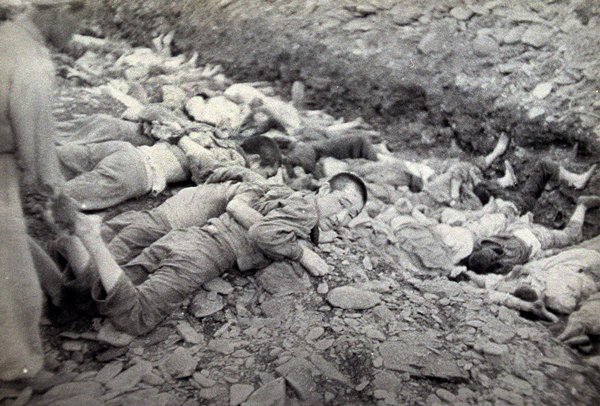
In June 1950, the U.S. orchestrated a United Nations invasion of Korea, and sent over 340,000 American troops. Over the next three years of combat and massive bombings, U.S. forces killed more than three million people: two million North Korean civilians, 500,000 North Korean soldiers, between 900,000 and a million Chinese soldiers, plus 1.3 million South Korean casualties, including 400,000 dead.4
|
Korean War 1950-53: U.S. Army photo depicts the summary execution of 1,800 South Korean political prisoners July 1950 carried out by the U.S.-installed puppet Syngman Rhee.
 | ||
U.S. nuclear threats against China and North Korea, 1950-1951
|
Truman
|
On November 30, 1950, Truman stated publicly that the U.S. was considering attacking Chinese and North Korean forces with nuclear weapons. That day, the Strategic Air Command was ordered to “be prepared to dispatch without delay medium bomb groups to the Far East ... this augmentation should include atomic capability.” Some in government advocated a “limited war” against China, including air attacks and a naval blockade. Gen. Douglas MacArthur, then in overall command of U.S. forces in Korea, argued for dropping 30 to 50 atomic bombs on Manchuria and Chinese cities. (Truman feared this would harm U.S. interests and fired MacArthur in the spring of 1951.)5
|
U.S. threatens nuclear attack against Iraq’s 1958 revolution
|
Eisenhower
|
After the pro-Western Iraqi monarchy was overthrown in a nationalist military coup, the U.S. threatened war against the new republic. U.S. forces, including the Strategic Air Command, were put on worldwide alert, and 70 naval vessels, hundreds of aircraft, and 14,000 Marines were dispatched to neighboring Lebanon. They reportedly included an atomic unit with artillery capable of firing nuclear shells. Eisenhower had secretly ordered the military to prepare to use nuclear weapons to prevent an Iraqi takeover of Kuwait’s oil fields. In response to U.S. threats and deployments, the Soviet Union began large scale maneuvers on its borders with Turkey and Iran. Until the makeup and intentions of the new Republic of Iraq became clear, general war was a real possibility, one journalist summed up.6
|
Vietnam War, 1961-1975
|
Eisenhower
John Kennedy (D)
Lyndon Johnson (D)
Richard Nixon (R)
Gerald Ford (R)
|
The U.S. sent military advisers, then over 500,000 troops, and dropped millions of tons of bombs in an effort to defeat the national liberation struggle of the Vietnamese people. By the time the war ended in America’s defeat in April 1975, its military had slaughtered some two million Vietnamese civilians and one million Vietnamese soldiers.7
|
My Lai massacre.
Photo: Wikimedia Commons 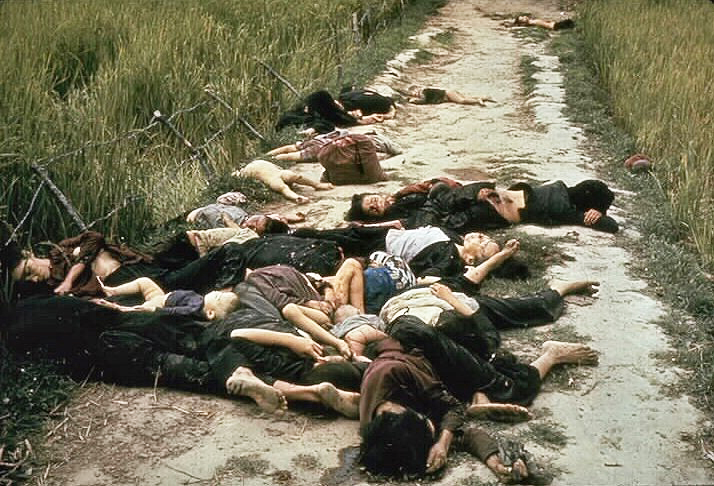 | ||
Planning for nuclear war with the Soviet Union and China, 1950s and ’60s.
|
Truman
Eisenhower
Kennedy
|
Whistleblower Daniel Ellsberg saw a copy of these war plans in 1961. He later wrote: “The total death toll as calculated by the Joint Chiefs, from a U.S. first strike aimed at the Soviet Union, its Warsaw Pact satellites, and China, would be roughly six hundred million dead. A hundred Holocausts.”8
|
The Bay of Pigs Invasion, 1961
|
Kennedy
|
The U.S. attempted to spark the overthrow of Cuba’s government, headed by Fidel Castro, by organizing this invasion by reactionary Cuban exiles. It was defeated, but during the fighting some 2,000 to 6,000 Cuban soldiers, militia personnel, and others were killed, wounded, or went missing in the first days of this U.S.-organized assault.9
|
Cuban Missile Crisis, 1962
|
Kennedy
|
The U.S. was carrying out secret operations to overthrow the Cuban government, and stationed nuclear missiles threatening the Soviet Union, in Turkey. At Cuba’s request, the Soviets placed 36 nuclear-armed missiles in Cuba. The U.S. demanded the missiles be removed, sent U-2 spy planes over Cuba (one was shot down), placed a naval blockade on Cuba, dropped depth charges near a disabled Soviet submarine, considered invading, and put its nuclear forces on DEFCON 2 alert, the highest level short of nuclear war. For 13 days, the world hovered on the brink of nuclear holocaust before the crisis was defused.10
|
Invasion of Dominican Republic, 1965
|
Johnson
|
On April 28, 1965, 22,000 U.S. Marines and other troops invaded the Dominican Republic in order to crush a just, mass uprising against the country’s pro-U.S. tyranny. Some 3,000 to 4,000 Dominicans were killed, although others estimated that the death toll was as high as 6,000 to 10,000.11
|
CIA orchestrates bloodbath in Indonesia, 1965-1966
|
Johnson
|
For many months, starting at the end of 1965, the reactionary, pro-U.S. Suharto regime slaughtered people with wild abandon. This massive bloodbath was set in motion, backed and orchestrated by the U.S., which provided the Suharto regime with equipment, weapons, and ultimately tens of billions of dollars. CIA advisers counseled Indonesian generals and provided them with a “hit list” of 5,000 to be taken out, then checked off their names when they’d been murdered. When the bloodletting ended at least 500,000, perhaps more than a million, people were killed, including members of the Communist Party of Indonesia (PKI), trade unionists, intellectuals, teachers, land reform advocates, ordinary peasants, ethnic Chinese, women, and children. Hundreds of thousands more were arrested and tortured.12
|
Bombing of Laos, 1965-73.
|
Johnson
Nixon
|
During the war in Vietnam, U.S. warplanes dropped two million tons of bombs on the small neighboring country of Laos, more than had been dropped on Germany or Japan during World War 2. These included anti-personnel cluster bombs. There’s been no accounting of those killed or wounded during the bombing, but over 20,000 people have been killed or maimed by unexploded ordinance—including cluster bombs—in the decades since the war ended.13
|
Bombing of Cambodia, 1969-1973:
|
Nixon
|
The U.S. also massively bombed Cambodia during the war in Vietnam, directly or indirectly killing 100,000 to 600,000 Cambodians—mostly civilians. Hundreds of thousands more likely died due to displacement, disease, and starvation in this period. Over two million people, more than 25 percent of its population, were driven from their homes in the countryside.14
|
Christmas bombing of North Vietnam: December 18-29, 1972.
|
Nixon
|
The U.S. massively bombed the densely populated cities of Hanoi and Haiphong. It claimed 1,600 Vietnamese civilians were killed, but Vietnamese sources estimate there were 2,300 civilian deaths—about 1,500 in Hanoi alone.15
|
CIA-orchestrated military coup in Chile, 1973
|
Nixon
|
Beginning in the early morning hours of September 11, 1973, the Chilean military, with political guidance and secret backing from the U.S., carried out a coup against the government of Chilean president Salvador Allende. More than 3,000 Chilean people were executed, thousands more disappeared, tens of thousands tortured; over 140,000 people were rounded up during the coup and in the few years that followed, and as many as one million people out of Chile’s population of 11 million were forced into exile.16
|
Supporting Indonesian genocide in East Timor, 1975-1999
|
Ford
Jimmy Carter (D)
Ronald Reagan (R)
George H.W. Bush (R)
Bill Clinton (D)
|
On the evening of December 6, 1975, President Ford and Secretary of State Henry Kissinger were in Jakarta, Indonesia, toasting America’s close ally, Indonesian dictator Suharto (who had been installed in power in a bloody CIA-backed coup in 1965) and green-lighting the Indonesian invasion of its neighbor, East Timor. “What followed was one of the greatest genocides of the 20th century. It is estimated that up to one-third of the Timorese population were killed through a policy of army massacre and enforced starvation. Many of those who were left were imprisoned and tortured by a military armed and trained by the United States.” The slaughter continued for almost 25 years. In 1999, after the majority voted for independence from Indonesia, pro-Indonesia forces murdered about 14,000 people. A few months later, the U.S. president—this time Clinton—was again meeting with Suharto to strengthen ties with this murderous regime.17
|
U.S. proxy war against the Soviet Union in Afghanistan, 1979-1989
|
Carter
Reagan
|
After the Soviet Union, the U.S.’s main imperialist rival, invaded Afghanistan in 1979, the U.S., along with Pakistan and Saudi Arabia, armed, organized and funded reactionary Islamic fundamentalist Mujahideen (who later became Afghanistan’s Taliban and Osama bin Laden’s Al Qaeda) to wage war against the Soviet forces and the Afghan regime it backed. When the Soviets finally pulled out of Afghanistan in 1989, between 800,000 and 1.5 million Afghans (along with 15,000 Soviet soldiers) had been killed in this reactionary bloodbath and five million Afghans, one-third of its population at the time had been driven out of the country as refugees.18
|
U.S. threatens tactical nuclear war over Iran, 1980
|
Carter
|
During and immediately after the 1979 Iranian revolution, the U.S. and the Soviet Union engaged in a series of high-stakes warnings and threats, backed by military maneuvers and nuclear alerts, as each tried to block the other from gaining ground in Iran. In August 1980, the U.S. warned the Soviets that any move into Iran would lead to a direct military confrontation Those options included the use of tactical nuclear weapons. For the first time, National Security Advisor Zbigniew Brzezinski later wrote, the United States deliberately sought for itself the capability to manage a protracted nuclear conflict.19
|
U.S. backs El Salvador death squads, 1980-92
|
Carter
Reagan
George H.W. Bush
|
To crush a guerrilla struggle against its brutal client regime, the U.S. supported, funded, and armed death squads which carried out extra-judicial executions and massacres that killed as many as 75,000 Salvadorans20
|
Fueling the Iran-Iraq War, 1980-1988
|
Carter
Reagan
|
In September 1980, Iraq’s Saddam Hussein invaded Iran with a green light from the U.S. Their common goal—to weaken or topple the new Islamic Republic. The U.S. supported both sides, at different points selling (or having allies sell) Iraq arms, including the capability to manufacture chemical and biological weapons, as well as providing military intelligence. For a short period, the U.S. also supplied Iran with weapons—“tilting” to one side or another to weaken both sides. This helped prolong the war and worsen the slaughter: Conservative estimates place the death toll at 262,000 to 367,000 Iranians and 105,000 Iraqis plus an estimated 700,000 injured or wounded on both sides.21
|
The U.S.-sponsored Contra war in Nicaragua, 1981-1988
|
Reagan
George H. W. Bush
|
The Sandinistas led the overthrow of the pro-U.S. Somoza dictatorship in 1978, and had friendly ties to the imperialist Soviet Union. The U.S. was determined to overthrow them. “For eight terrible long years, the people of Nicaragua were under attack by Washington’s proxy army, the Contras, formed from Somoza’s vicious National Guardsmen and other supporters of the dictator. It was all-out war… burning down schools and medical clinics, raping, torturing, mining harbors, bombing and strafing.” As many as 50,000 people were killed. In 1990 the U.S. forced a “free election” with the threat of escalated terror if people supported the Somoza government. It fell. Today, Nicaragua is one of the poorest and most violence plagued nations in the hemisphere.22
|
U.S. backed genocide in Guatemala, 1982-1983
|
Reagan
|
In 1982, the U.S. backed a military coup by the Christian fanatic General José Efraín Ríos Montt, who then launched a genocidal assault on Guatemala’s indigenous Mayan population; with U.S. aid and support Guatemala’s military systematically destroyed more than 600 indigenous Mayan villages and slaughtered some 75,000 people. The Guatemalan military regime’s savage, U.S.-supported war against leftist opponents and peasants (which had begun in the 1960s) continued until 1996. During those decades it’s estimated that some 200,000 people were disappeared or killed.23
|
1982-1983: Armed and backed by the U.S., the Guatemalan military systematically destroyed more than 600 indigenous Mayan villages and slaughtering some 75,000 people.
 | ||
Invasion of Grenada, 1983
|
Reagan
|
The U.S. invaded this small island nation to overthrow its leftist government, an action the UN denounced as a “flagrant” violation of international law. U.S. forces killed 45 Grenadians and 25 Cubans working there in support of Grenada’s government and wounded a total of 396 Grenadians and Cubans.24
|
America’s complicity in the massacre of Iraqi Kurds, 1987-1988
|
Reagan
|
After facilitating Iraq’s development of chemical weapons, the U.S. turned a blind eye and continued to support the Hussein regime when it used them against Iraq’s Kurds, massacring as many as 60,000 people, including as many as 5,000 in one gas attack at Halabja, according to an Iraq scholar. A Defense Intelligence Agency (DIA) officer told the New York Times that the Pentagon “wasn’t so horrified by Iraq’s use of gas. It was just another way of killing people—whether with a bullet or phosgene, it didn’t make any difference.”25
|
The shoot-down of Iran Air Flight 655, 1988
|
Reagan
|
On July 2, 1988, the naval warship USS Vincennes shot down an unarmed Iranian civilian passenger jet—Iran Air Flight 655—as it flew over the Persian Gulf. All 290 passengers on board were killed.26
|
The Invasion of Panama, 1989-1990
|
George H.W. Bush
|
On December 20, 1989, the U.S. military invaded Panama with 27,684 troops and 300 aircraft, removing Manuel Noriega and his Panamanian Defense Force (PDF) from power. Whole neighborhoods were destroyed and an estimated 3,000-6,000 Panamanians—mainly civilians—were killed.27
|
On December 20, 1989, the U.S. military invaded Panama with 27,500 troops and 300 aircraft, killing thousands of civilians and removing Manuel Noriega. (Photo: AP)
 | ||
The Persian Gulf War—the U.S. assault on Iraq, 1990-1991
|
George H.W. Bush
|
From January 16 until February 27, 1991, the U.S. led a massive war of aggression, based on lies, against Iraq. Some 100,000 Iraqi soldiers were killed and another 300,000 wounded. The war also caused the deaths of 70,000 civilians by January 1992.28
|
U.S.-UN killer sanctions on Iraq, 1990-2003
|
George H.W. Bush
Clinton
George W. Bush (R)
|
In 1990, the U.S. and UN imposed a crippling economic blockade on Iraq, and then U.S. bombers destroyed much of Iraq’s infrastructure, including its electrical, water, and sewage treatment systems, during the January-March 1991 Persian Gulf War. By 1997, the UN reported that more than 1.2 million Iraqis had died since the beginning of the Gulf War as a result of medical shortages caused by the war and sanctions, including 750,000 children under the age of five. A 1999 survey found that Iraqi children under five were dying at more than twice the rate they were before the Gulf War. That’s roughly 5,000 Iraqi children under five dying each month thanks to U.S. actions.29
|
Iraq, 2004
Iraqi woman seeks treatment for her three-month-old son suffering from dehydration due to U.S. sanctions. (Photo: AP)  | ||
Military intervention in former Yugoslavia, Bosnia 1994-95; Serbia, 1999
|
Clinton
|
In the 1990s, the multi-national Republic of Yugoslavian was torn apart by the forces of reactionary nationalism, egged on, backed, and manipulated by Germany, Russia, the U.S., and other imperialist powers seeking to gain advantage. A complex series of brutal wars erupted in which over 100,000 died. At various points, NATO—under U.S. command—intervened in order to shape the outcome in U.S. interests, carrying out its own war crimes. In April 1999 alone, NATO planes conducted hundreds of runs, bombing the city of Pristina in Kosovo, killing 10 civilians and leveling dozens of homes; Aleksinac, Serbia, where they destroyed an apartment complex, killing 12 and wounding 50; the bridge over the Juzna-Morava River, including two bombing runs on a train crossing the river, killing 10 passengers; the Kosova farming village of Meja, killing 20; and a refugee convoy south of Djakovica, killing 80.30
|
Invasion and occupation of Afghanistan, 2001-present
|
George W. Bush
Barack Obama (D)
Donald Trump (R)
|
In October 2001, U.S. forces invaded Afghanistan, drove the Taliban regime from power, and installed a widely hated, pro-U.S. “Islamic Republic,” but has never succeeded in defeating the Islamic fundamentalist Taliban or stabilizing the country and the fighting and U.S. bombing has continued ever since. By August 2016, some 111,000 people had been killed and over 116,000 injured. More than 31,000 of the dead were Afghan civilians.31
|
Afghanistan, 2008
Children killed by U.S. airstrike in Kabul, Afghanistan, 2008. (Photo: AP)  | ||
Invasion, occupation, and ongoing intervention in Iraq, 2003-present
|
George W. Bush
Obama
Trump
|
In 2003, the U.S. invaded Iraq and overthrew Saddam Hussein and his regime based on the lie Iraq possessed weapons of mass destruction. The U.S. war and occupation led to the rise of reactionary Islamic jihadism, armed resistance, and ethnic-sectarian conflict which continues to this day. From 2003 to 2016, 251,000 Iraqis had been killed in the war, including between 168,239 and 187,378 civilians. Other studies of estimate that between 1.2 and 1.4 million (and perhaps as many as 2.4 million) have died from the war’s direct and indirect impacts. More than 4.2 million Iraqis had been injured and at least 4.5 million driven from their homes by 2016.32
|
US, British, French war on Libya, 2011
|
Obama
|
In March 2011, the U.S., Britain, and France seized on a mass uprising against Muammar Qaddafi’s oppressive, 42-year-long rule, to launch a war. Their goal: overthrow him and tighten their grip on Libya. For the next seven months, the U.S.-led coalition carried out extensive bombing raids and military operations. By October, between 10,000 and 30,000 had been killed and Qaddafi’s regime had been shattered. Libya was turned into a battleground between reactionaries, and life became a nightmare for the masses, with shortages of food, water, and electricity, a third of the population without medical care, and a half million people forced to flee their homes.33
|
Arming, backing, and enabling the Saudi-led war in Yemen, 2015-present
|
Obama
Trump
|
In March 2015, Saudi Arabia, with U.S. arms, technical support, and political backing, launched a war against Yemen’s Houthi movement which had taken power. Since then, between 57,000 and 60,000 have been killed, mainly by Saudi air strikes. The Saudis have bombed Yemen’s food, water, and medical systems, causing massive hunger and disease. At least 85,000 children have starved to death as a result, and in 2016 and 2017 alone, 113,000 children died of starvation or preventable disease. Now, 14 million Yemenis are on the brink of famine.34
|
U.S. support for Israel’s wars, 1948-present
|
Truman
|
The Nakba (1948). Israel was created by defeating armies from Egypt, Jordan, Syria, and Iraq in war, and by violently forcing Palestinians from their lands and homes. Between 1947 and 1949, at least 750,000 Palestinians—of a population of 1.9 million—were expelled and made refugees. Zionist forces took more than 78 percent of historic Palestine, ethnically cleansed and destroyed about 530 villages and cities, and killed about 15,000 Palestinians in a series of mass atrocities, including more than 70 massacres. The U.S. supported the foundation of Israel, seeing an opportunity to undercut British influence in the region. One of Truman’s aides also argued that Israel could become a strategic asset, a kind of stationary aircraft carrier to protect American interests in the Mediterranean and the Middle East.35
|
Johnson
|
1967 War [“Six-day War”] (June 5, 1967-June 10, 1967). In 1967, there was a brief but bloody military assault by Israel against Egypt, Syria, and Jordan. Israel Defense Forces sealed the “special relationship” between the U.S. and Israel. Israel launched preemptive air strikes that crippled the air forces of Egypt and its allies and then staged a successful ground offensive. Israel seized the Sinai Peninsula and the Gaza Strip from Egypt; the West Bank and East Jerusalem from Jordan; and the Golan Heights from Syria. Egypt’s casualties numbered more than 11,000, with 6,000 for Jordan, and 1,000 for Syria, compared with only 700 for Israel. This overwhelming military victory impressed on U.S. strategic thinkers that Israel was the key ally to ensure American domination in the Middle East. The U.S. began providing Israel cutting edge jet fighters, the beginning of a massive flood of U.S. military aid that continues to this day. This established Israel’s military superiority over Arab regimes, and Israel increasingly functioned as an American proxy and attack dog, not only in the Middle East, but around the world.36
| |
Nixon
|
1973 Arab-Israeli War (October 6, 1973—October 26, 1973) started after a coalition of Arab states led by Egypt and Syria fought to regain lands that had been seized by Israel in the 1967 War. The war took place mostly in Sinai and the Golan Heights—occupied by Israel during the 1967 Six-Day War—with some fighting in African Egypt and northern Israel. The lowest casualty estimate is 8,000 (5,000 Egyptians and 3,000 Syrians) killed and 18,000 wounded. The highest estimate is 18,500 (15,000 Egyptians and 3,500 Syrians) killed. The U.S. fully backed Israel, even putting its nuclear forces on alert as a warning to the Soviets against intervening unilaterally in the war. It saw this (and the June 1967 war) as intended to bludgeon the surrounding Arab countries, in particular Egypt and Syria, and to demonstrate as Kissinger put it, the limits of Soviet influence. They were also aimed at crushing the Palestinian liberation struggle, then the region’s most revolutionary and broadly influential movement.37
| |
Reagan
|
1982 Lebanon War (June 1982-September 1982)
Israel Defense Forces invaded southern Lebanon with the goals of expelling the Palestine Liberation Organization (PLO), removing Syrian influence over Lebanon, and installing a pro-Israeli Christian government. By the end of the second week, International Red Cross and Lebanese police figures claimed up to 14,000 people died and 20,000 were injured, mostly civilians. During the Siege of Beirut, by late August 1982, Lebanese sources put the death toll in Beirut at 6,776. Lebanese police and international doctors serving in Beirut put the share of civilian casualties at about 80 percent. All factions in the conflicts agree that between 4,000 and 5,000 civilians died during the siege, caused by military activity of all sides. While there may have been some within the Reagan administration concerned about the potential fallout from Israel’s attack, the U.S. continued to staunchly support Israel overall, including the need to crush the Palestinian resistance and other anti-U.S. forces in the region.38
| |
George W. Bush
|
Massacre in Gaza, 2008-09: Between December 27, 2008 and January 19, 2009, Israel waged a war of wanton destruction and death against the people of Gaza—killing between 1,166 and 1,417 people, including 844 unarmed civilians, 281 of them children. On January 9, Democrats and Republicans in both houses of Congress voted overwhelmingly in support of Israel’s actions, declaring -- in direct opposition to the findings of Amnesty International, Human Rights Watch, the International Red Cross and other humanitarian organizations – that Israel’s armed forces bore no responsibility for the large numbers of civilian casualties from their assault on Gaza.39
| |
Obama
|
2014 Gaza War—Jul 8, 2014—Aug 26, 2014 2,251 Palestinians were killed, including 1,462 Palestinian civilians, of whom 299 were women and 551 children; and 11,231 Palestinians, including 3,540 women and 3,436 children, were injured... of whom 10 percent suffered permanent disability as a result. Again, both Democrats and Republicans in the House and Senate passed resolutions unanimously supporting Israel’s slaughter.40
| |
Trump
|
2018—the Great March of Return
weekly protests began March 30, 2018 at Gaza’s border with Israel. They demanded that Israel’s crippling blockade of Gaza be lifted and that Palestinian refugees have the right to return to their homes stolen by Israel in the 1948 war. They were also fueled by the Trump/Pence regime’s decision to move the U.S. embassy to Jerusalem – a big “fuck you” to the Palestinian people and a green light for Israeli ethnic cleansing. Unarmed protests have continued since then, and as of October 2018 over 150 Palestinians have been killed in the demonstrations. At least 10,000 others have been injured, including 1,849 children, 424 women, 115 paramedics and 115 journalists. Of those injured, 5,814 were hit by live ammunition. The Trump/Pence regime responded by blaming the unarmed Palestinians for the violence. Since its founding, the U.S. has given Israel a staggering $134 billion in aid – including over $94 billion in military aid – far more than its given to any other country.41
| |
U.S. Drone Strikes in Yemen, Afghanistan, Pakistan, and Somalia,2002-Present.
|
George W. Bush
Obama
Trump
|
In Yemen, Afghanistan, Pakistan and Somalia, tens of millions of people live in daily danger of terrorist attack—from U.S. drones. People gathered in groups at wedding parties, tribal meetings, or car convoys have been slaughtered by America’s remote-controlled high-tech death machines. In the dehumanizing jargon of the U.S. military, people killed by drones on purpose are referred to as “jackpots” while unintended deaths are referred to as “EKIAs”—“Enemies” Killed in Action—a category that includes women, children, and people bombed in homes or at social gatherings.
Following the September 11, 2001 attack on the Pentagon and World Trade Center, under the George W. Bush administration the U.S. launched the so-called “war on terror” -- a global war to expand and strengthen the U.S. empire by going after all manner of forces the U.S. rulers considered obstacles or opponents. Then after taking office in 2009, the Obama administration greatly stepped up the number of unmanned drone attacks, launching more than 300 against Pakistan alone—six times the number ordered by Bush—as well as dozens more against Yemen, Somalia, and perhaps other countries in the region. Drones have been used over Libya and in spy operations against Iran. They’re deployed from dozens of secret facilities in the Middle East, Africa, and Southwest Asia, directed from operational hubs in the U.S.—where the buttons are pushed and the missiles launched, thousands of miles away from the bloodshed.
Totals to date:
Minimum Confirmed Strikes: 5,861
Total Killed: 8,289-11,792
Civilians Killed: 758-1,619
Children Killed: 252-36942
|
1. American Crime Case #97: August 6 and 9, 1945—The Nuclear Incineration of Hiroshima and Nagasaki, revcom.us, May 23, 2016 [back]
2. American Crime #49: 1950-53— Encircling, Threatening and Attacking the Chinese Revolution, revcom.us, January 1, 2018; William Blum, Killing Hope – U.S. Military and CIA Interventions Since World War II (Common Courage 1995), pp. 21-23; Alpha History, “The Chinese Civil War,” 2018. [back]
3. Blum, Killing Hope, pp. 34-39; “Greek Civil WAR (1946-1949),” The Apricity. [back]
4. American Crime #49: 1950-53— Encircling, Threatening and Attacking the Chinese Revolution, revcom.us, January 1, 2018. [back]
5. American Crime #49: 1950-53— Encircling, Threatening and Attacking the Chinese Revolution, revcom.us, January 1, 2018. [back]
6. Larry Everest, Oil, Power & Empire – Iraq and the U.S. Global Agenda (Common Courage, 2004), pp. 113-114 [back]
7. American Crime #96: Vietnam, March 16, 1968 – The My Lai Massacre, revcom.us, May 23, 2016. [back]
8. Daniel Ellsberg, The Doomsday Machine – Confessions of a Nuclear War Planner, p. 3 [back]
9. American Crime #45: The Bay of Pigs Invasion, 1961, revcom.us, February 12, 2018 [back]
10. The Nuclear Close Calls: The Cuban Missile Crisis, Atomic Heritage Foundation, June 15, 2018. [back]
11. American Crime #68: The 1965 U.S. Invasion of Dominican Republic, revcom.us #476, January 28, 2017. [back]
12. American Crime Case 100: "1965 Massacre in Indonesia," revcom.us, May 2, 2016. [back]
13. <Killing Hope, p. 88; “The Bombing of Laos: By the Numbers,” ABC NEWS, September 6, 2016 6 [back]
14. American Crime Case #47: The Bombing of Cambodia, 1969-1973, revcom.us #526, January 15, 2018 [back]
15. American Crime Case #34: America's 1972 Christmas Bombings North Vietnam, revcom.us, December 17, 2018. [back]
16. American Crime Case #57: The 1973 CIA Coup in Chile, revcom.us, October 22, 2017; William Blum, Rogue State – A Guide to the World’s Only Superpower (Common Courage, 2000), p. 143 [back]
17. “Massacre: The Story of East Timor,” Democracy Now, November 12, 1997 [back]
18. Oil, Power & Empire, p. 90; The Soviet Invasion of Afghanistan, 1979 – 1989, ThoughtCo.com [back]
19. Oil, Power & Empire, pp. 91-93, Ellsberg, p. 321 [back]
20. American Crime Case #38: The U.S. Backs El Salvador’s Death Squad Government, 1980 to 1992,” revcom.us, July 9, 2018. [back]
21. Oil, Power & Empire, p. 99 [back]
22. Rogue State, P. 146-147; “Legacy of Civil Wars - In Central America, Reagan Remains A Polarizing Figure,” Washington Post, June 10, 2004 [back]
23. American Crime Case #95: Reagan's Butcher Carries Out Genocide in Guatemala, revcom.us, #441, May 30, 2016 [back]
24. Cole, Ronald (1997). “Operation Urgent Fury: The Planning and Execution of Joint Operations in Grenada” [back]
25. Oil, Power & Empire, pp. 113-114 [back]
26. Oil, Power & Empire, p. 111 [back]
27. American Crime Case #43: The U.S. Invasion of Panama, 1989-1990, revcom.us, April 23, 2018 [back]
28. American Crime Case #32: The 1991 Persian Gulf War, "Operation Desert Storm", revcom.us, December 17, 2018. [back]
29. American Crime Case #76: U.S.-UN Sanctions On Iraq,"A Legitimized Act of Mass Slaughter, revcom.us, #461, October 17, 2016. [back]
30. "Yugoslavia: The American Way of War - "Destroying the Village to Save It," Revolutionary Worker #1003, April 25, 1999. [back]
31. Costs of War -- Update on the Human Costs of War for Afghanistan and Pakistan, 2001 to mid-2016, Watson Institute, Brown University. [back]
32. American Crime Case #70: Operation Iraqi Freedom, 2003, revcom.us, December 5, 2016; and "Iraq conflict has killed a million Iraqis: survey," Reuters, January 30, 2008; "1.3 million children displaced by Iraq's war with Islamic State: UNICEF," Reuters, January 19, 2018; "The Staggering Death Toll in Iraq," Medea Benjamin, Nicolas J. S. Davies, AlterNet, March 15, 2018. [back]
33. American Crime Case #35: The U.S.-Nato War on Libya, revcom.us, September 3, 2018 [back]
34. “85,000 Children in Yemen May Have Died of Starvation,” New York Times, November 21, 2018; “Yemeni children die as warring sides block aid deliveries: UNICEF,” Reuters, NOVEMBER 2, 2018; “Saudi Arabia Escalates Genocidal, American-Backed War in Yemen-U.S. Rulers Maneuver as 14 Million Yemenis on Brink of Starvation,” revcom.us, November 26, 201 [back]
35. Oil, Power & Empire, p. 61; McDowall, David; Claire Palley (1987). The Palestinians. Minority Rights Group Report no 24. p. 10; The Nakba did not start or end in 1948-Key facts and figures on the ethnic cleansing of Palestine. 23 May 2017, www.aljazeera.com [back]
36. "Six Day War,' Encyclopaedia Britannica, November 26, 2018 [back]
37. Gawrych, George (2000). The Albatross of Decisive Victory: War and Policy Between Egypt and Israel in the 1967 and 1973 Arab-Israeli Wars; Herzog, Encyclopaedia Judaica, Keter Publishing House, 1974, p. 87; Oil, Power & Empire, p. xxxxxx, Ellsberg, p. 321. [back]
38. Fisk, Robert (2001). Pity the Nation: Lebanon at War. Oxford University Press; Molly Dunigan (28 February 2011). Victory for Hire: Private Security Companies’ Impact on Military Effectiveness. Stanford University Press. pp. 103 [back]
39. American Crime Case #30: Israel’s U.S.-Armed and -Backed Massacre in Gaza (2008-2009), revcom.us, December 17, 2018; Congressional Support for Israel’s War on Gaza Shows Bipartisan Hostility toward International Law" Huffington Post, March 19, 2009 [back]
40. “Key figures on the 2014 hostilities - Data featured in the Report of the Independent Commission of Inquiry on the 2014 Gaza Conflict,” United Nations Office for the Coordination of Humanitarian Affairs, Occupied Palestinian Territory, June 23, 2015; "U.S. Senate Unanimously Approves Resolution Giving Full Support of Israel on Gaza," HAARETZ, July 20, 2014 [back]
41. “U.S.-Israeli Massacre Kills 60 Palestinians and Wounds Over 2,700: Everyone Must Stand Up and Protest Against These Crimes Against Humanity!,” Revcom.us, May 14, 2018;, Seven Protesters Killed, Two of Them Children, and 257 Injured at Friday Demonstrations in Gaza, Al Mezan Center For Human Rights, September 29, 2018; “Total US Foreign Aid to Israel 1949-Present, JewishVirtualLibrary.org [back]
42. Drone Warfare, The Bureau of Investigative Journalism. [back]
Now that you’ve read this article, take a moment to consider the crucial role this website plays. In this world of multiplying crises and growing horrors, there are answers, and there are solutions, but people are being systematically lied to and misled by this system’s representatives. Revcom.us/Revolution sharply exposes this system’s crimes, analyzes the need and possibility for an actual revolution and a whole different way the world could be, and shows how people can work now in a unified way for revolution. It is a key way for people to engage with and spread the work and leadership of Bob Avakian, the leader of this revolution and the architect of a new framework for revolution, the new synthesis of communism.
We urge you to become a sustainer of revcom.us and to donate generously. Thousands of dollars are urgently needed now to maintain, expand, and publicize our site, to support staff, dispatch correspondents, and more.

Keine Kommentare:
Kommentar veröffentlichen